Wednesday, 11 January 2012

Glittering Louvered Ad Astra Skyscraper is Topped With a Pyramid Heliport


Atkins Architecture has proposed a gorgeous new mixed-use tower overlooking the Black Sea on Georgia’s coast for clients Sustainable Growth Investments. Called the Ad Astra Building, the glass and steel structure will glitter on the Batumi skyline. The skyscraper’s louvered facade reduces solar gain by 40%, and its top supports a heliport for the company helicopter.


The 45 story tower was inspired by traditional Georgian stone towers that dot the lush hills of the region. A diagonally gridded steel exoskeleton will support the interior glass tower, bearing vertical loads while creating a stunning myriad of glass. The tower will be crowned with a translucent pyramid that accentuates the triangular pattern of the outside. Beneath the exterior triangles is a system of louvers, which creates shade and privacy throughout the entire building. The louvers also help prevent solar gain, keeping the inside cool. Coupled with glazing, the louvers and the building’s exoskeleton reduce solar gain by 40%.

The pyramid atop the tower does not just create a visual peak – it also opens to reveal the building’s heliport. The triangular sides are lowered, and the square base acts as the landing pad. The Ad Astra Tower will be home to a 5 star hotel, offices, retail space, luxurious penthouse apartments, an events hall, a champagne lounge, and a sky restaurant below the helioport.

The tower will be a symbol of the new developments in the Georgian city of Batumi. Its glistening top will be viewable from points all over the city, as well as from the Greater Caucasus Mountains nearby.

Monday, 9 January 2012

6 Awesome Caves to Call Home


Cavemen may have had it right all along - with a few modern amenities, cave dwellings are not only exotic places to call home, but also extremely energy-efficient. Their natural walls regulate temperatures all year-round, and many caves have natural fresh water sources flowing through them. Check out some of our favorite modern cave abodes across the globe - some are even available to rent by the night for your own cave adventure!

CHULO CANYON CAVE HOUSE

The Chulo Canyon Cave House is a retreat in the Mule Mountains outside of Bisbee, Arizona. Set on 37 acres of mountainous terrain, the 3,000 square foot home is accessible through a sun room, which leads to the underground dwelling. A high end kitchen, Morrocan dining area with chandelier, living room, yoga space and 3 bedrooms keep naturally cool thanks to the cave walls. Several natural pools, a guest house and vegetable garden also flank the property.

MISSOURI CAVE LAND

Once a concert venue, the owners of this home in Festus, Missouri first bought the cave property on Ebay. The massive 17,000 square foot home is divided into three chambers. The front portion houses the living areas and three bedrooms, the middle houses utilities, laundry, and a large party room and the back still has the historic stage where MC5, Ted Nugent and Tina Turner once played! Three freshwater springs and fourteen waterfalls are also located on the magical property.

SALA SILVERMINE

If caves bored into the side of mountains aren’t wild enough for you, you and a guest can sleep 500 feet below ground in Sweden’s historic Sala Silvermine suite. The mine itself was a leading producer of silver during the 16th century all the way to the 20th century when it closed. A network of beautiful underground halls offer unique dining, small concerts, and can be rented for weddings or private parties, which can be arranged around an underground lake.

CAVE PALACE RANCH

Cave Palace Ranch in Utah is built into the side of a natural red rock cave, on 110 acres of land. Four interior alcoves have been beautifully transformed into a master bedroom with deck, living room, dining area, two bedrooms and a sleeping loft. The entire home is impressively powered off the grid thanks to a system of solar panels. The window front façade floods the interior with light, while fresh waters is sourced from an underground well.

BECKHAM CREEK CAVE LODGE

The Beckham Creek Cave Lodge in Arkansas is a rental property dedicated toward the preservation of natural beauty. The glass front fills the interior with light while connecting the living walls inside to the nature outside. Each private and common room boast the cave’s natural ambience, and the grounds provide adventure in the beautiful Ozark countryside.

IRAN’S CAVE HOMES

Originally built over 700 years ago, the cave homes near Mount Sahand in Iran were carved in the side of the volcanic rock mountains. Now a popular area for hotels and resorts, the cave rooms keep cool during the day thanks to the natural insulation and deflection of solar gain. The interiors are decked with traditional and historical textiles, rugs and pillows for modern comfort.


Wednesday, 28 December 2011

6 Incredible Buildings Made from Ice and Snow


Icy winter weather is well on its way, but while most of us are turning up the thermostat, several creative designers are turning that below zero chill into incredible examples of ice architecture. We've scoured the world's coldest corners to bring you a flurry of beautiful buildings and interiors that have been built from ice and snow. From a Tron-inspired ice suite in Sweden to a sparkling snow castle in Finland to an icicle-laden citadel built in Minnesota, hold on tight to your hot cup of joe and hit the jump for a sampling of some of the coolest frozen structures on earth.

TRON ICE HOTEL SUITE


In anticipation of the release of 3D TRON: Legacy, last year a set of Ben Rousseau and Ian Douglas–Jones created a suite at the famous IceHotel above the Arctic Circle in Sweden. The electric blue Tron-inspired lighting scheme was achieved by cutting grooves into the ice, inserting energy efficient EL wire and then icing over the wire to keep it in place. The “Legacy Of The River” suite, was part of their campaign to launch a new line of illuminated furniture and products, which debuted earlier this year.

QUEBEC’S HOTEL DE GLACE

Every January the gorgeous Hotel De Glace in Quebec City opens to the public, and visitors are invited to sleep in artistically designed ice rooms. Made almost entirely from snow and ice, the hotel changes design and shape each winter. The hotel even boasts an ice chapel where lovebirds — who didn’t fly south for the winter — can wed.

HARBIN INTERNATIONAL ICE AND SNOW SCULPTURE FESTIVAL

For nearly 30 years, hundreds of thousands of people have flocked to the Harbin International Ice and Snow Sculpture Festival in northeast China to witness dazzling works of manmade ice architecture. Chunks of ice are brought in from the frozen Songhua River and molded by talented sculptors into jaw-dropping life-size creations, which are placed throughout the city.

RUSSIAN ICE PALACE

The ice palace in St. Petersburg, Russia first appeared in 1740 as the handiwork of Empress Anna Ivanovna to celebrate victory in the Turkish war. In 2005 historians worked to recreate the structure with a team of 14 ice masters led by famous ice-sculptor, Valerij Gromov. Following detailed plans left by architect Pyotr Yeropkin centuries ago, the ice palace was rebuilt to include the 20 meters tall by 50 meters wide palace, a garden filled with ice trees and an ice statue of an elephant. The interior of palace is also furnished with furniture made of ice, including an ice bed with ice mattress and pillows. The palace is reconstructed every year.

GEOTHERMAL ICE CASTLES

Ice man Roger Hanson decided to pass on building boring backyard snowmen, spending the last four years growing himself larger than life ice castles instead. Using a geothermal heating system, special sprayers and a computer program he created himself, Hanson builds crystalline masterpieces that get bigger and more elaborate every year.

FINLAND’S LUMI LINNA SNOW CASTLE

The SnowCastle of Kemi by the Gulf of Bothnia in Finland is a source of great pride for locals, and a showcase of the architectonic “snowmanship” of its constructors. Construction of the SnowCastle starts in December and it takes approximately 5 weeks to complete. Because natural snow is too soft, the castle’s builders make new snow out of the sea water using snow pipes. The SnowCastle 2012 will be open January 28th, 2012.


Monday, 26 December 2011

Gorgeous Origami-Esque Klein Bottle House Nestles Into Australia’s Landscape


The Klein Bottle House is a gorgeous structure that has been recognized for its funky origami twist and modern aesthetic. In response to an awkward site astride Rye Beach's dramatic landscape in Australia, McBride Charles Ryan gave the house the shape of a "Klein Bottle" - a mathematical non-orientable surface that has no boundary and does not distinguish between left and right. If that's a little hard to wrap your head around, know that despite its complex geometric design, this home is actually very livable. More cool photos and details after the jump.


McBride Charles Ryan is known for manipulating form and function in a way that is still harmonious with the natural landscape. Although abstract, this home’s spiral configuration was somewhat necessary to ensure the smallest amount of site disruption and is arranged to be comfortable inside. Designed to be a weekend home, it is modestly sized and centered around a lovely courtyard and an internal stairway connects the various levels.

Like origami, the home with its snazzy facade clad mostly in cement sheeting, appears to be folded in on itself even though it features a traditional stud frame foundation. With a foyer, courtyard, laundry, three bedrooms, and a whole pile of natural light, this gorgeous home is somewhat evocative of the ubiquitous fibro-shacks that Australians recall so fondly as an integral part of the country’s beach architecture. This award-winning project nestled into the dramatic Mornington Peninsula is a classic example of serious cool that is also bright green.

Thursday, 22 December 2011

1000 Recycled Doors Transform the Facade of a 10-Story Building in Seoul


South Korean Artist Choi Jeong-Hwa used 1000 brightly colored recycled doors to transform a bland 10-story building into an eye-popping visual indulgence. Jeong-Hwa is a master of using found objects to make provocative spaces, and the project is one of his most ambitious attempts to place normal things in an extraordinary way. The doors stretch up the scaffolding of the mid-rise, giving the hulking mass a pixelated charm.


Choi Jeong-Hwa’s imagery is born out his desire to let art engage with the greater population. His work is almost delusional – he takes ordinary, often discarded items and uses them to create unique spaces.

1000 Doors engages with the entire city of Seoul through its immense scale. The mass of doors reads like a crazy advertisement from afar. Up close, the juxtaposition of the common doors scaling the full height of the building is a bit jarring, if not amusing.

The piece makes a statement about how art changes how we see, as Jeong-Hwa puts it: “People think you can only find Korean Art in Museums and Galleries” for “other artists”. The ambiguity and strength of his work rests in the tactile quality of the discarded object itself.

Tuesday, 20 December 2011

Top 10 spookiest buildings around the world


Have you ever visited a building that gave you the creeps? These 10 buildings around the world are guaranteed to send a shiver down your spine.

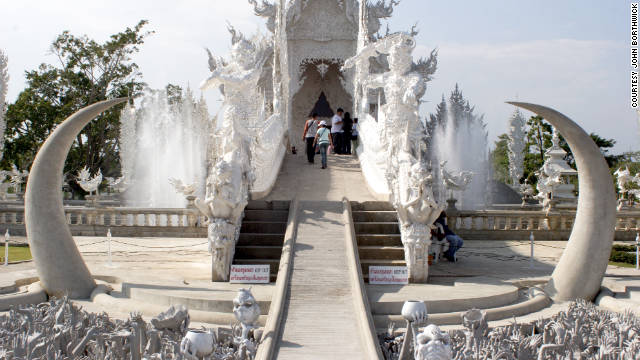
1. Wat Rong Khun, Chang Rai, Thailand

Still under construction, Chiang Rai's controversial modern temple is part traditional Buddhist temple, part white-frosted wedding cake, and part avant-garde art with a disturbing penchant for pointiness. Visitors must cross a bridge to the temple over a field of fangs and hundreds of pleading white arms and suffering faces of statues reaching up from hell. While stark whiteness predominates, the inside and other parts of the temple compound (including the toilets) are sparkling gold.

Wat Rong Khun is open daily; the White Temple is a short drive from Chiang Rai.

2. Sedlec Ossuary, Kutná Hora, Czech Republic

By the mid-1800s, the crypt at the Sedlec monastery had been a popular burial site for centuries, with plague outbreaks and Hussite Wars contributing thousands of remains. In the 1870s a local woodcarver was hired to make creative use of the bones that had been piling up in the crypt. This was no minor task: the ossuary contains the remains of over 40,000 people, many of which were used to decorate the chapel. The effect is as beautiful as it is macabre: elaborate light fixtures, arrays of bells, furnishings, splashy wall treatments and coats of arms are all loving recreated from skulls and bones of all sizes. Is that chandelier staring back at you?

To reach the monastery, drag your bones 800m south from Kutná Hora's main train station.

3. Ryugyong Hotel, Pyongyang, North Korea

Under construction since 1987, the massive and still unfinished 105-story Ryugyong Hotel in Pyongyang looks like a luxury hotel designed for Mordor. Nicknamed the 'Hotel of Doom' and described as 'the worst building in the history of mankind' by Esquire, construction halted due to lack of funding, and the partially completed building stood windowless and looming ominously over the city for 16 years before work resumed in 2008. Strikingly modern when first designed, time has not been kind to the building, which now looks simultaneously menacing, dated, and unconscionably extravagant relative to the impoverished populace.

Once granted a visa, visitors to North Korea have little choice in where they are allowed to visit or photograph, but at 105 stories, the Ryugyong Hotel is hard to miss from anywhere in the capital.

4. Dongyue Temple, Běijīng, China

Běijīng's most morbid shrine, the operating Taoist shrine of Dongyue Temple is an unsettling but fascinating place to visit. Stepping through the entrance you find yourself in Taoist Hades, where tormented spirits reflect on their wrongdoings. The 'Life and Death Department' is a spiritual place to ponder your eventual demise, the 'Department for Wandering Ghosts' and the 'Department for Implementing 15 Kinds of Violent Death' have slightly less inviting names, while the ill might seek out the 'Deep-Rooted Disease Department'. Other halls are less morbid, but no less interesting. Visit during the Chinese New Year or the Mid-Autumn Festival to see the temple at its most vibrant.

Paying the extra Yuan for a guide can be helpful for interpreting the aspects of the temple that might otherwise defy explanation.

5. Lemp Mansion, St Louis, USA

Reputed to be one of the USA's most haunted houses (if there are degrees of hauntedness), St Louis' Lemp Mansion has a long history of odd occurrences. Charles Lemp committed suicide in the house in 1949 and, ever since, strange things have taken place at the house, including doors that swing open spontaneously, glasses that leap off tables and break, and a tragically short-lived reality TV show. Today, the mansion operates as a restaurant and inn that capitalizes on the morbid fame through murder mystery dinner theatre, Halloween parties and weekly tours by a noted 'paranormal investigator'. Stay the night if you dare.

The mansion can be found just off I-55, south of the Anheuser-Busch Brewery.

6. Scott Monument, Edinburgh, Scotland

A spiky Gothic fantasy with more than a passing resemblance to a Thai temple, the monument to Sir Walter Scott is a beloved fixture of the Edinburgh skyline. Just 61m high, the climb to the top doesn't sound daunting until you find yourself wedged into the preposterously tiny spiral staircase. The final curve is so notoriously tight that squeezing yourself out the final doorway requires the flexibility of a spelunker. Edinburgh mystery writer Ian Rankin once set the scene of the crime at the top of the Scott Monument, with much of the story focusing on the physics of getting a stiff cadaver down the twisty staircase. Not a claustrophobe? This might make you think otherwise.

7. Catacombe dei Cappuccini, Palermo, Italy

All of the inhabitants of the catacombs below Palermo's Capuchin Monastery are decked out in their Sunday best. Unfortunately, that Sunday was several hundred years ago, and the outfits have fared significantly better that the wearers. The mummified bodies and skeletons of some 8000 Palermitans from the 1600s through to the 1800s are kept in the catacombs for all to see, some so well preserved that they look eerily lifelike. Men and women occupy separate corridors, and within the women's area there's a special virgin-only section. Spooky for adults, probably terrifying for the kiddies - be warned.

The catacombs are a 15-minute walk from Palermo's Piazza Independenza along Via Cappuccini or a short bus ride.

8. Chernobyl Reactor #4, Ukraine

Famously the site of the world's biggest nuclear disaster in 1986, the 30km-radius exclusion zone is mostly uninhabited today, but limited tours have been available since 2002 for travelers who are curious enough to get a glimpse of the industrial ghost town and aren't put off by the ominous click of a Geiger counter. Factories, homes, schools, and a particularly creepy abandoned amusement park stand decaying and choked with weeds, but remain much as they looked at the time of disaster. The Ukrainian government has indicated that the exclusion zone will be increasingly open to travelers in the coming years. Just don't step on the radioactive moss.

The best way to visit Chernobyl is to use one of the several Kiev-based agencies such as Solo East or New Logic.

9. Ottawa Jail Hostel, Canada

Want to spend the night in the slammer? Why not make it a jail haunted by the spirits of former inmates and deemed unsuitable for prisoners in the early1970s due to appalling conditions? Opened in 1862, the Carleton County Gaol was in operation for over a century, but it was hardly a hit with the prisoners who complained of cramped conditions and sanitation problems. It might not have been suitable for prisoners at the time, but if you're a traveler on a tight budget and don't mind that your room happens to be a prison cell and your bunkmate might be spectral, it's perfect. As a 'prisoner' today, your punishment includes parking, wifi, and a games lounge.

10. White Alice, Alaska, USA

A gold-rush town a century ago and the finishing line for the Iditarod dog-sled race today, Nome is the perfect example of a honky-tonk, almost-at-the-Arctic-Circle frontier town. Overlooking the town and the Bering Straits from the top of Anvil Mountain is White Alice, a weird Cold War relic. From down in the town it looks like a bizarre space-age Stonehenge, closer up it could be a film set for a shoot of the Victorian-era War of the Worlds. The four strange corrugated-iron sound reflector structures were intended for listening to suspicious Soviet activity.


Friday, 16 December 2011

Missing Link Builds an Awesome Indoor Treehouse Inside Their New South African Office


If you had a treehouse INSIDE your office, would you ever want to go home? That's the concept behind Missing Link's extraordinary design for their lively new headquarters in South Africa. The presentation firm had to receive special permission to bring in a 6 ton tree that died of natural causes, which they then converted into an adorable treehouse complete with a cozy gathering area underneath. But that's not the end of it - with a budget of $120,000 and only 6 weeks to get from design to completion, the team scoured Johannesburg scrap yards and secondhand shops to find a range of unconventional recycled materials to create what they call "orchestrated chaos."


Samantha Dean is Missing Link’s Managing Director and one of several people who went without sleep and fought with contractors on a daily basis in order to bring this incredible project to fruition. “Richard (our CEO) is the biggest kid we have, so a fireman’s pole and slide were TOP of the list of HAVE to haves. Our space is very much a mesh of a lot of ideas from a bunch of people over time,” she said.

The 1,250 square feet office in Fourways also features a bath converted into a table, a faux camper van concession space, and the work of Graffiti master Nic Hooper of Shakewell, all of which reflect a refreshing take on the ideal work environment. Samantha said, “I think the biggest thing for me is that we are proof that you don’t need to work in a gray walled cubical farm to be productive. And we’re not a bunch of crazy ‘creatives’ – we make presentations for banks (amongst others).” She added, “You spend 66% of your life at work (and us often more so)– why not make it as much fun as possible?” We couldn’t agree more.